Between gut feeling and bias: making fair decisions in recruiting.

How did your last job interview go? Do you remember your first impression? Was it positive – or rather disconcerting? Did you think, "I fit in with the team" or "I just don't seem right"?
Such impressions often arise in a matter of seconds. But what are they based on? Intuition? Experience? Or unconscious assumptions?
Our gut feeling plays an important role in recruiting. It provides quick clues – such as "a good fit" or "a bad fit." But if we rely too heavily on it without asking questions, intuition bias can arise. Our judgments are then distorted by personal experiences or stereotypes – usually unconsciously.
The difference: Gut feelings are instinctive and can be helpful when combined with critical thinking. Unconscious bias, on the other hand, is unintentional, biased judgments that make objective decisions difficult – often without us even noticing.
In recruiting, this means: A positive first impression can be valuable. But it should always be complemented by clear, structured criteria to ensure decisions remain fair and competency-based.
This distinction isn't easy here, but it's crucial. First impressions are influential, even when we believe we're objective.
And that has consequences—for opportunities, for diversity, and for the question of who is even invited to the interview.
1. What a name can (unfortunately) reveal
An experiment from Switzerland shows that a person's name can significantly influence their chances of getting an interview. In one study, over 800 applications were sent out – identical profiles but different names.
The result: Applicants with foreign-sounding names had to write around 30% more applications to receive the same number of invitations as people with typically Swiss names.
Other characteristics also have an impact: An international meta-analysis of 18 studies shows that openly homosexual applicants are around 40% less likely to receive positive feedback – especially in less qualified jobs
Interestingly, applications that highlight personal or social aspects such as volunteer work, soft skills or awards are less likely to be discriminated against .
What helps:
✔️ Anonymize applications in early stages
✔️ Define clear criteria for selection and evaluation – focus on competencies instead of assumptions
✔️ Retain additional fields for soft skills, engagement, or awards
✔️ Diversity in the selection committee
Sources:
Do Swiss Citizens of Immigrant Origin Face Hiring Discrimination in the Labor Market?( NCCR – on the move, 2023)
Meta-analysis on hiring discrimination against homosexuals (Alexandre Flage, 2022)
2. Recruit fairly despite bias: When your head needs a break
The timing of the decision can also play a role. An ETH study examining 150,000 applications in Switzerland shows:
🕒 Shortly before lunch and after work, discrimination increases by 20%. When we're tired and under time pressure, we're more likely to resort to stereotypes – unconsciously.
Further findings:
Women in male-dominated industries: 7% fewer contacts
Men in female-dominated areas: 13% less
Candidates with a migration background: 6.5% fewer chances , with increasing "cultural distance" the effect increases
What helps:
✔️ Standardized rating systems
✔️ Clear CV screening and interview criteria
✔️ Conscious breaks and joint reflection sessions after selection processes
3. More women – but how long do they stay?
Another factor: structural hurdles – even where diversity appears to have already arrived. One example: The current white paper "The Unseen Code: Unlock Switzerland's Female Tech Potential," with data from around 20 Swiss tech companies, shows:
The proportion of women among employees is 30%, in junior management 21% and in senior management only 18%.
In terms of the proportion of women graduating in STEM subjects, Switzerland ranks third from last among all OECD countries.
Inhibiting structures:
Women tend to be judged on performance , men on potential
Leadership is still often defined by constant availability
Missing part-time models
Unpaid care work is hardly taken into account
The result: Many talented women stagnate or drop out, even though they have the skills to offer.
What you can do:
✔️ Transparent promotion criteria
✔️ Offer part-time leadership roles
✔️ Introduce bias-sensitive performance evaluations
✔️ Integrate family work into development plans
✔️ Promote a culture in which presence and flexibility are equally important
Sources:
Conclusion
Discrimination in the application process is rarely malicious—but often unconscious and systemic. This is precisely why it's so important to critically examine your own processes and raise awareness of unconscious bias . Only then can you ensure that what really counts is competence, motivation, and potential.
Let’s work together to create structures where it’s not name, timing, or gender that counts – but talent and attitude.
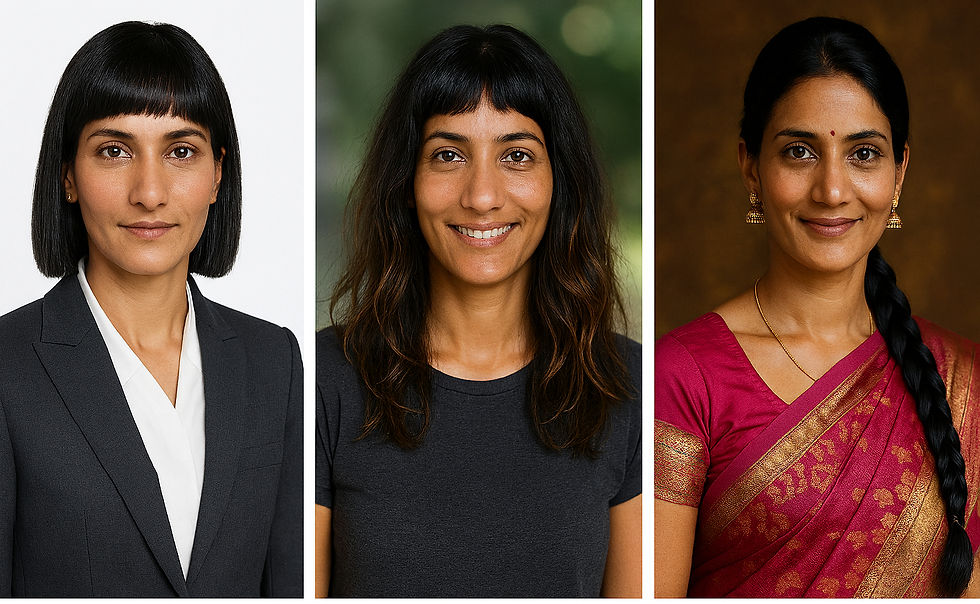
PS: How much does your impression change of the woman in the different pictures? And how would that influence your gut feeling in the interview?